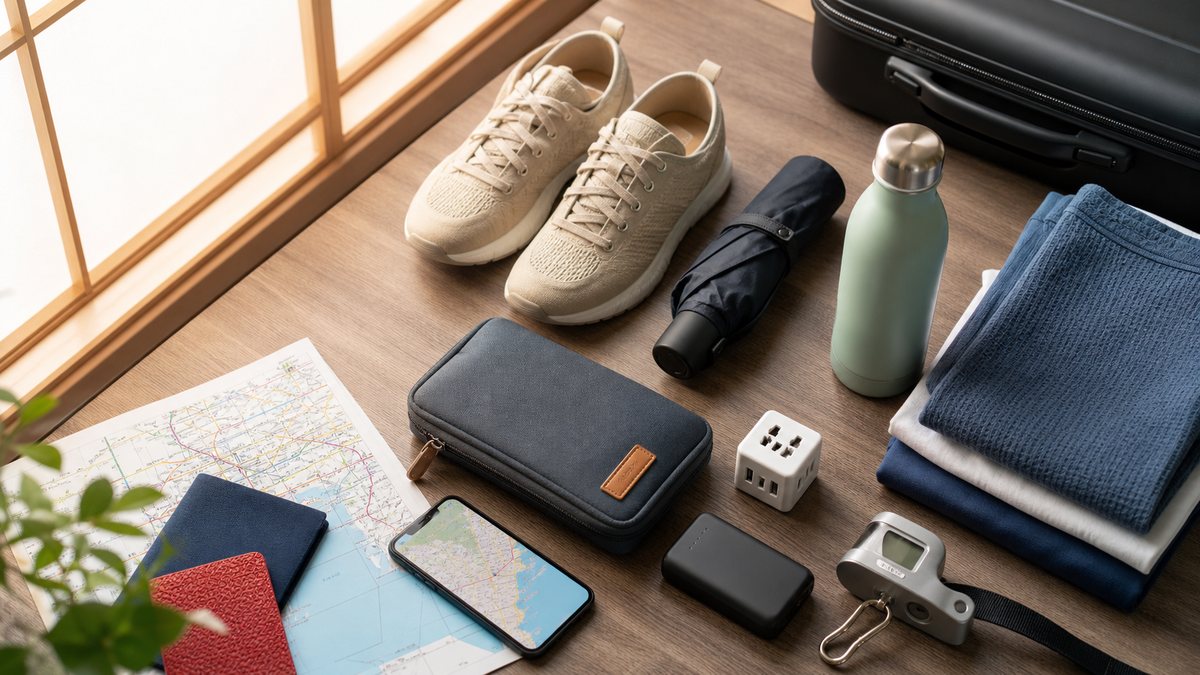
Research checked on July 29, 2026. This Japan packing list is written for first-time visitors who want to avoid the small mistakes that make a trip feel harder: sore feet, summer heat, dead phone batteries, oversized luggage stress, and medication confusion at the border.
Japan is easy to travel in, but it is not always easy to pack for. You may walk more than expected, move through crowded stations with luggage, stay in smaller hotel rooms, and switch between hot streets, cold trains, rainy days, temples, restaurants, and long-distance trains in the same trip.
This guide focuses on what to bring before you fly, what to buy only if it fits your route, and what rules to check before packing. Some product links are PR affiliate links, but the logic is simple: buy only what removes real travel friction.
QUICK ANSWER
For a first Japan trip in 2026, prioritize comfortable walking shoes, breathable layers, a compact umbrella, a carry-on-safe power bank, medication paperwork, a luggage scale, and a reliable internet plan. If you are riding the Shinkansen with a large suitcase, measure the bag before booking tickets.
PR / PACKING SHORTCUTS
If you only buy a few things, start with the items that solve the most common Japan travel problems.
- walking shoes on Amazon Japan / walking shoes on Rakuten
- power banks on Amazon Japan / mobile batteries on Rakuten
- compact UV umbrellas on Amazon Japan / compact umbrellas on Rakuten
- luggage scales on Amazon Japan / luggage scales and suitcase belts on Rakuten
- packing pouches on Amazon Japan / packing cubes on Rakuten
For a broader shopping list, also see the Ryu Journal travel gear checklist.
Before You Pack: What Makes Japan Different
Japan has very different climates depending on region and season. The Japan Meteorological Agency describes eastern Japan as having hot and humid summers, while western Japan can have very hot and humid summers with temperatures sometimes reaching 35 degrees Celsius or above. That matters if your itinerary includes Tokyo, Kyoto, Osaka, Hiroshima, or Kyushu in summer.
Heat is not the only packing issue. The Ministry of the Environment heat illness site uses WBGT, a heat stress index, and publishes heat-stroke alert information. For travelers, the practical takeaway is simple: hydration, shade, breathable clothing, and flexible sightseeing plans matter.
Japan also has rules that affect what you bring. The Ministry of Health, Labour and Welfare explains that some medicines require import confirmation before entering Japan. The FAA PackSafe lithium battery guidance says spare lithium batteries and power banks should be kept with the passenger in the aircraft cabin. On certain Shinkansen routes, JR Central says oversized baggage over 160 cm total dimensions requires a seat reservation with oversized baggage space.
1. Comfortable Walking Shoes You Have Already Tested
Japan is not the place to break in brand-new shoes. A normal day can include station stairs, long underground passages, temple approaches, museum queues, convenience-store detours, and late-night walks back from dinner.
Pack one main pair that you can wear all day and one backup option if your trip is longer than a week. Avoid shoes that look good for photos but punish you after 20,000 steps.
Buy before flying: walking shoes on Amazon Japan or walking shoes on Rakuten.
2. Breathable Layers for Heat, Trains, and Restaurants
For summer, bring breathable tops, quick-dry inner layers, and clothing that still feels comfortable when humidity is high. For spring and autumn, layers matter because mornings and evenings can feel cooler than midday.
Even in hot months, trains, department stores, and restaurants can feel cool compared with the street. A light overshirt, cardigan, or thin packable layer is more useful than it looks.
3. Compact UV Umbrella or Rain Umbrella
A small umbrella is useful in more seasons than people expect. It helps with sudden rain, strong sun, and long exposed walks between stations and attractions.
If you visit in rainy season or deep summer, choose something compact enough to keep in your day bag. The best umbrella is the one you actually carry.
Useful shortcut: compact UV umbrellas on Amazon Japan or compact umbrellas on Rakuten.
4. Reusable Water Bottle
You can buy drinks everywhere in Japan, but a reusable bottle still helps. It keeps you from ignoring hydration because you are rushing between trains, and it reduces the number of small purchases you make during a hot day.
For summer travel, think of this as a safety item, not a lifestyle accessory.
5. Portable Fan or Cooling Towel for Summer Trips
If you visit Japan from June through September, heat planning becomes part of the itinerary. A small fan, cooling towel, or neck-cooling item can make queues, open-air temples, and station transfers feel less draining.
This is especially useful for Kyoto, Osaka, Tokyo, Hiroshima, and theme-park days, where you may spend long stretches outdoors.
Summer comfort: portable fans on Amazon Japan / cooling towels and fans on Rakuten.
6. Carry-On-Safe Power Bank
Your phone becomes your map, translation tool, train planner, camera, hotel confirmation, ticket wallet, and payment backup. A small power bank is one of the highest-value Japan travel items.
Do not pack it carelessly. Airline and country-specific rules can vary, but spare lithium batteries and power banks should generally stay in your carry-on cabin bag, not checked luggage. Check your airline before flying, especially if your power bank has a high capacity.
Phone backup: power banks on Amazon Japan / mobile batteries on Rakuten.
7. USB-C Charger and Travel Adapter
Many travelers pack cables but forget the charging setup as a system. You may need to charge a phone, camera battery, earbuds, pocket WiFi, power bank, and watch with limited hotel outlets.
Japan uses Type A and Type B-style outlets. If your plugs do not match, bring an adapter. If your devices already use compatible plugs, a compact multi-port USB charger may be more useful than a bulky universal adapter.
Charging setup: USB-C travel adapters on Amazon Japan / USB-C travel adapters on Rakuten.
8. eSIM or Pocket WiFi Plan
This is not a physical packing item for everyone, but it belongs on the checklist. Do not land in Japan planning to solve internet later if you need maps immediately.
An eSIM is convenient for solo travelers with compatible unlocked phones. Pocket WiFi can make sense for groups or travelers with older phones. Read this before deciding: Japan eSIM vs Pocket WiFi 2026.
9. Luggage Scale
A luggage scale is small, cheap, and boring, which is exactly why people forget it. It becomes useful when you buy snacks, cosmetics, clothes, character goods, and souvenirs faster than expected.
It also helps before Shinkansen days. Weight is not the same as the JR oversized-baggage rule, but knowing whether you can lift and manage your suitcase matters in crowded stations.
Before souvenirs win: luggage scales on Amazon Japan / luggage scales and suitcase belts on Rakuten.
10. Suitcase Belt or Smart Tag
Japan is orderly, but luggage still moves through airports, hotels, lockers, forwarding counters, and station platforms. A suitcase belt makes your bag easier to spot and adds a small layer of practical security. A smart tag can help you confirm where your luggage is, especially if you use forwarding or multiple hotels.
Do not rely on this instead of normal travel insurance or airline support. Treat it as a convenience tool.
11. Packing Cubes or Flat Travel Pouches
Hotel rooms in Japan can be compact. Packing cubes help because you can open one pouch instead of exploding your whole suitcase across the room.
They are also useful for separating clean clothes, laundry, electronics, and small medical items.
Stay organized: packing pouches on Amazon Japan / packing cubes on Rakuten.
12. Small Day Bag
Your main suitcase should not follow you everywhere. Bring a small day bag that can hold water, umbrella, power bank, passport copy, tissues, and anything you need for a long sightseeing day.
If you plan temple visits, food markets, or museums, choose something that is easy to carry in crowds and easy to place at your feet.
13. Handkerchief or Small Towel
A small towel is surprisingly useful in Japan. You may use it after washing your hands, during summer walks, at parks, or when a sudden rain shower catches you between stations.
This is a tiny item that often becomes part of your everyday travel rhythm.
14. Wet Wipes and Pocket Tissues
Convenience stores sell both, but having them on your first day helps. They are useful for snacks, train meals, public restrooms, picnic-style lunches, and kids.
Pack a small amount, then restock locally if needed.
15. Medication, Prescriptions, and Paperwork
Do not assume every medicine that is normal at home is simple to bring into Japan. Check active ingredients, quantities, and whether import confirmation is required. Keep prescriptions and medical notes organized, especially for controlled or long-term medication.
This is one of the few parts of packing where guessing is not good enough. Use the official MHLW page and confirm before departure if your medication is important.
16. A Small Coin and Card Setup
Japan is more cashless than it used to be, but small payments still happen. A simple coin pouch or slim wallet helps with lockers, small temples, older shops, and backup cash.
If you use a mobile IC card, great. If not, keep a simple transit and cash setup that you can use when tired.
17. Copies of Key Documents
Keep a digital copy of your passport, insurance, hotel confirmations, major tickets, and emergency contacts. Also keep one offline version somewhere you can reach if your phone battery dies.
This is not exciting, but it is the kind of preparation that saves a bad day from becoming a ruined day.
What Not to Overpack for Japan
Too many formal outfits: Most sightseeing days reward comfort more than variety.
Huge toiletries: Japan is excellent for convenience-store and pharmacy basics, though specific foreign brands may not always be available.
Oversized luggage for short trips: If your suitcase total dimensions exceed 160 cm on certain Shinkansen routes, you need to plan ahead. Read the full guide here: Shinkansen luggage rules for first-time visitors.
Too many just-in-case items: Japan rewards mobility. If you can easily buy it at a convenience store, pharmacy, or department store, it may not need to fly with you.
Best Packing Strategy by Season
Spring: light layers, comfortable shoes, compact umbrella, allergy items if you need them, and space for shopping.
Summer: breathable clothing, UV umbrella, water bottle, portable fan or cooling towel, spare socks, and a slower sightseeing schedule.
Autumn: layers, light jacket, shoes that handle rain, and a day bag for long city walks.
Winter: warm layers, gloves, dry socks, moisturizer, and stronger planning if you visit Hokkaido, Tohoku, or mountain areas.
Related Japan Planning Guides
- Japan Travel Mistakes 2026
- Japan eSIM vs Pocket WiFi 2026
- Shinkansen Luggage Rules 2026
- Best Japan Activities to Book Before Your First Trip
- Ryu Journal Travel Gear Checklist
FAQ
Do I need a huge suitcase for Japan?
Usually no. A medium suitcase plus a small day bag is easier for stations, hotel rooms, and trains. If your suitcase is large, measure it before Shinkansen travel.
Should I buy a power bank before going to Japan?
Yes, if you rely on your phone for maps, translation, tickets, and photos. Keep it in your carry-on cabin bag and check your airline battery rules before flying.
Is summer in Japan really that hot?
It can be. Official climate information describes hot and humid summers in eastern Japan and very hot, humid summers in western Japan. Pack for shade, hydration, and slower sightseeing.
Can I bring my medication to Japan?
Often yes, but some medicines and quantities need extra procedures. Check the official MHLW information before your flight instead of relying on old forum answers.
Final Thoughts
The best Japan packing list is not the longest one. It is the one that protects your walking days, your phone battery, your luggage transfers, your health, and your first hour after landing.
If you are planning a first Japan trip in 2026, save this checklist before you buy gear. Then buy only the items that solve real problems for your route.
