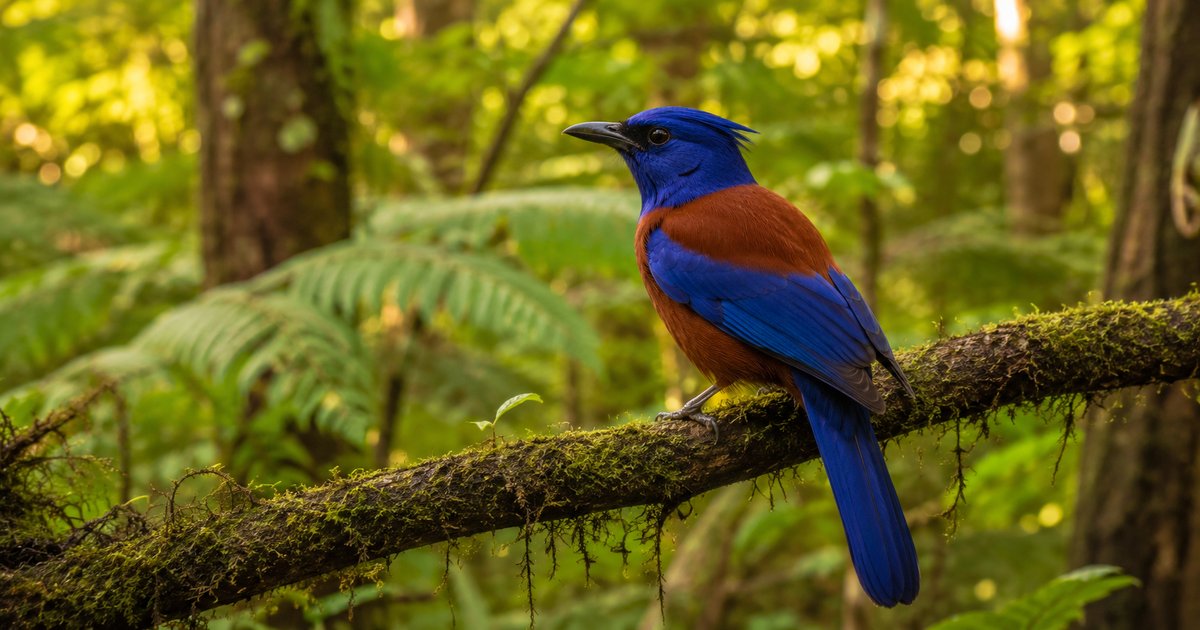
Amami-Oshima, a UNESCO Natural World Heritage island midway between Kyushu and Okinawa, harbours a remarkable collection of endemic and rare forest birds in dense subtropical jungle. The island’s isolation has produced evolutionary novelties found nowhere else on Earth, making it one of Asia’s most exciting birding destinations.
Star Birds
Amami Woodcock
The Amami Woodcock is a large, elusive forest bird endemic to the Amami Islands. Active primarily at night, it feeds in humid forest floor leaf litter and performs dramatic roding (display flights) over the forest at dusk. Spotlighting tours from forest tracks give the best chances of sightings.
Lidth’s Jay
Lidth’s Jay — one of the world’s most spectacularly coloured corvids, with electric blue, chestnut, and white plumage — is endemic to Amami-Oshima and Tokunoshima. It inhabits mature broad-leaved forest and is readily found by its loud calls.
Ruykyu Robin
The Ryukyu Robin, a shy rufous-and-white thrush-like bird, sings persistently from dense undergrowth. Japanese Wood Pigeon, White-backed Woodpecker, and Ijima’s Leaf Warbler are other endemics to look for. Winter brings many migratory thrushes and flycatchers from mainland Asia.
Best Time to Visit
- Winter (Nov-Mar): Forest birds most active; best for woodcock; winter migrants present
- Spring (Apr-May): All forest birds singing at peak activity
- Summer (Jun-Sep): Humid and hot; typhoon risk increases
Travel Tips
Amami-Oshima is served by direct flights from Tokyo (2.5 hours), Osaka, and Kagoshima. The main town Naze has hotels and car rental. The road through the central mountains (particularly around Sumiyoshi-Kinsakubaru) is the best forest birding route. Night tours with a local guide specialising in endemic species are highly recommended.
