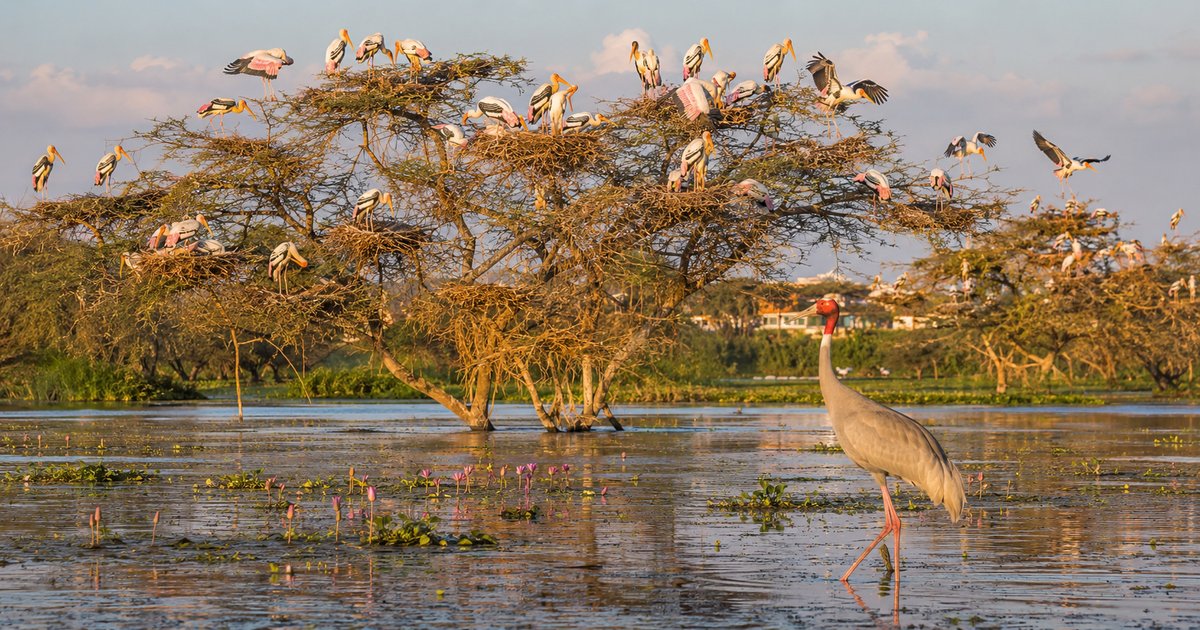
Keoladeo National Park (formerly Bharatpur Bird Sanctuary) in Rajasthan, India, is a UNESCO World Heritage Site and one of Asia’s most important wetland bird sanctuaries. This former royal hunting reserve — its wetlands managed for over a century to attract waterbirds — now hosts extraordinary concentrations of breeding herons, storks, and migratory ducks within a compact and easily explored area.
Star Birds
Painted Stork
Thousands of Painted Storks breed in the acacia forest, their pink wing-tips visible in nesting colonies of extraordinary density. Mixed with breeding Grey Herons, Eurasian Spoonbills, Little Egrets, and Night Herons, the heronry is one of India’s greatest wildlife spectacles.
Sarus Crane
The Sarus Crane — the world’s tallest flying bird at 1.8 metres — breeds in wetlands adjacent to the park and feeds in agricultural fields nearby. Pairs mate for life and their bugling calls carry for kilometres. India holds over 95% of the world’s remaining Sarus Crane population.
Winter Migrants
Winter transforms Keoladeo as migrants flood in from Central Asia and Siberia. Bar-headed Goose, Greylag Goose, Common Crane, Northern Pintail, Gadwall, and Ferruginous Duck arrive in large numbers. The Critically Endangered Siberian Crane formerly wintered here in small numbers — recent records have been increasingly rare.
Best Time to Visit
- Oct-Mar: Peak winter migrants; cool temperatures; excellent visitor conditions
- Jul-Sep: Breeding season; monsoon; heronry active but hot
Travel Tips
Bharatpur is on the Agra-Jaipur road, making it an easy addition to the classic Golden Triangle itinerary. The park is best explored by bicycle or cycle-rickshaw (available for hire at the gate). Early morning and late afternoon are optimal. Guides are available and recommended — their knowledge of individual bird locations is invaluable.
