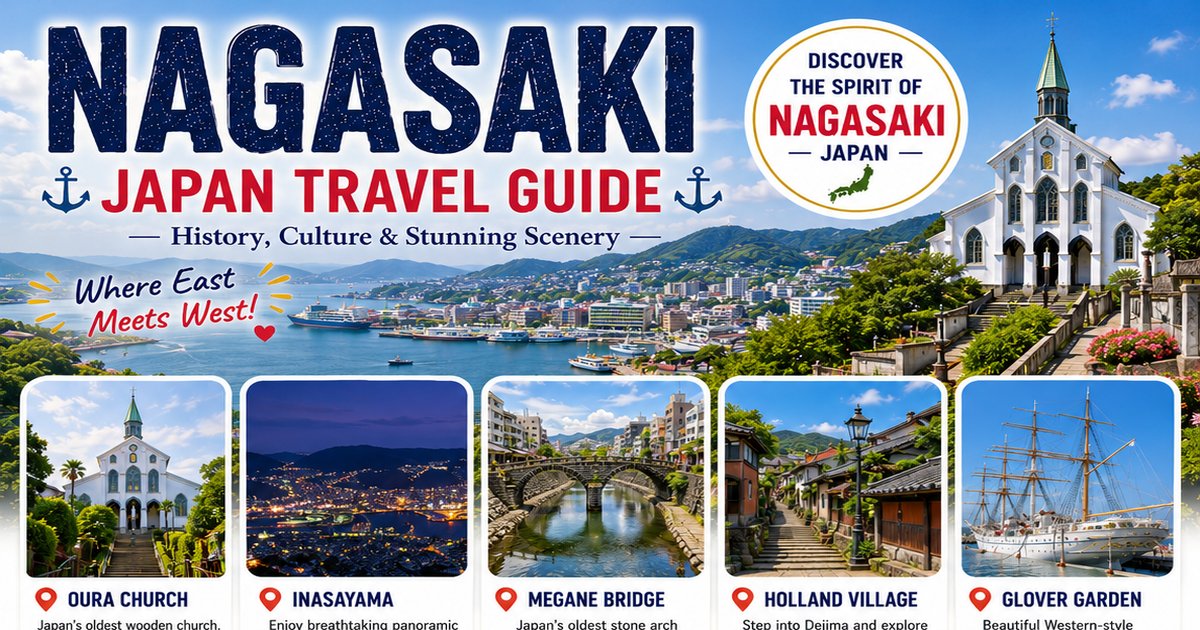
Nagasaki is unlike anywhere else in Japan — a city shaped by centuries as Japan’s only open port to the outside world during the Edo Period. Portuguese, Dutch, and Chinese influences permeate its architecture, cuisine, and culture, creating a uniquely cosmopolitan city with a profound and complex history.
Top Attractions
1. Peace Park & Atomic Bomb Museum
Nagasaki was the second city struck by an atomic bomb, on August 9, 1945. The Peace Park and Hypocenter Park are sites of deep reflection, and the museum tells the human story of that day with extraordinary compassion.
2. Dejima & Glover Garden
Dejima was the artificial island where Dutch traders were confined during Japan’s isolation period — the sole conduit for Western knowledge into Japan for over 200 years. Glover Garden on the hillside above the harbor preserves the Western-style mansions of 19th-century foreign merchants.
3. Gunkanjima (Battleship Island)
The abandoned industrial island of Hashima (nicknamed Battleship Island for its shape) was once the world’s most densely populated place. Now a UNESCO World Heritage Site, boat tours to this atmospheric ruin are unforgettable.
Food & Drink
Chanpon (thick noodles in creamy pork and seafood broth — created by a Chinese chef in Nagasaki in 1899) is the city’s signature dish. Sara Udon, Castella (Portuguese sponge cake — a 400-year-old Nagasaki tradition), and Kakuni Manju (braised pork belly buns) are essential.
Getting There
From Fukuoka (Hakata), the Kamome Shinkansen reaches Nagasaki in about 30 minutes.
