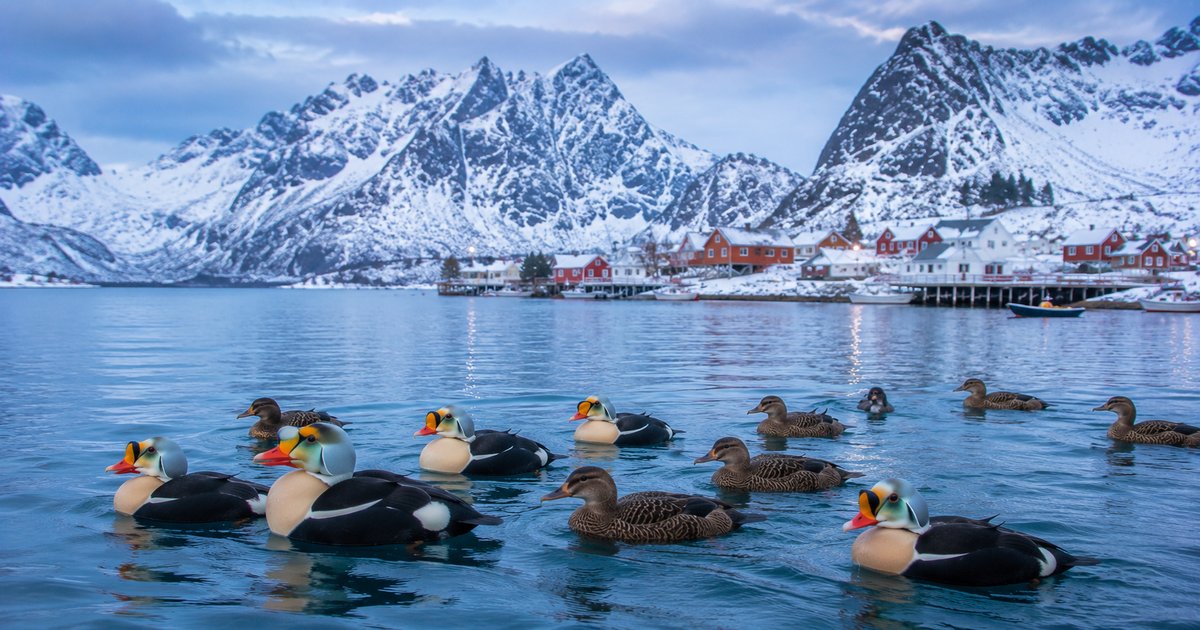
The Varanger Peninsula in Arctic Norway — stretching into the Barents Sea at 70 degrees north — is Europe’s premier Arctic birding destination. In winter, extraordinary seaducks, gulls, and raptors concentrate in this remote wilderness of frozen fjords and wind-scoured tundra. In summer, millions of seabirds breed on the dramatic coastal cliffs.
Star Birds
King Eider
The magnificent King Eider — the male’s extraordinary orange, blue, and black head design making it arguably the world’s most beautiful duck — winters in the cold waters off Varanger in flocks of hundreds. The best viewing is from the pier at Batsfjord, where birds feed close inshore in the harbour. Mixed flocks with Common Eider and Long-tailed Duck add to the spectacle.
Ivory Gull
The ghostly white Ivory Gull — a pure Arctic specialist that breeds on pack ice — appears at Varanger in winter, particularly at fishing harbours and around fishing boats. Finding an Ivory Gull among the crowds of Iceland and Glaucous Gulls is a thrilling challenge.
Steller’s Eider
Small numbers of Steller’s Eiders — a compact, fast-flying seaduck — winter reliably in the Varanger Fjord, particularly near Vardo. This declining species is increasingly rarely seen in Europe, making Varanger one of the last reliable locations.
Best Time to Visit
- Nov-Mar: Peak for seaducks and arctic gulls; possibility of Snowy Owl and Gyrfalcon
- May-Jul: Breeding season; tundra birds singing; midnight sun; Snowy Owl nesting in good lemming years
Travel Tips
The nearest airport is Vadsoe, reached via Tromso or Oslo. Kirkenes (served by international charter flights) is also used as a base. A rental car is essential for covering the extensive fjord coastline. Winter temperatures drop well below minus 20 degrees Celsius — extreme cold-weather clothing is required. Local birding contacts can provide up-to-date rare bird information.
