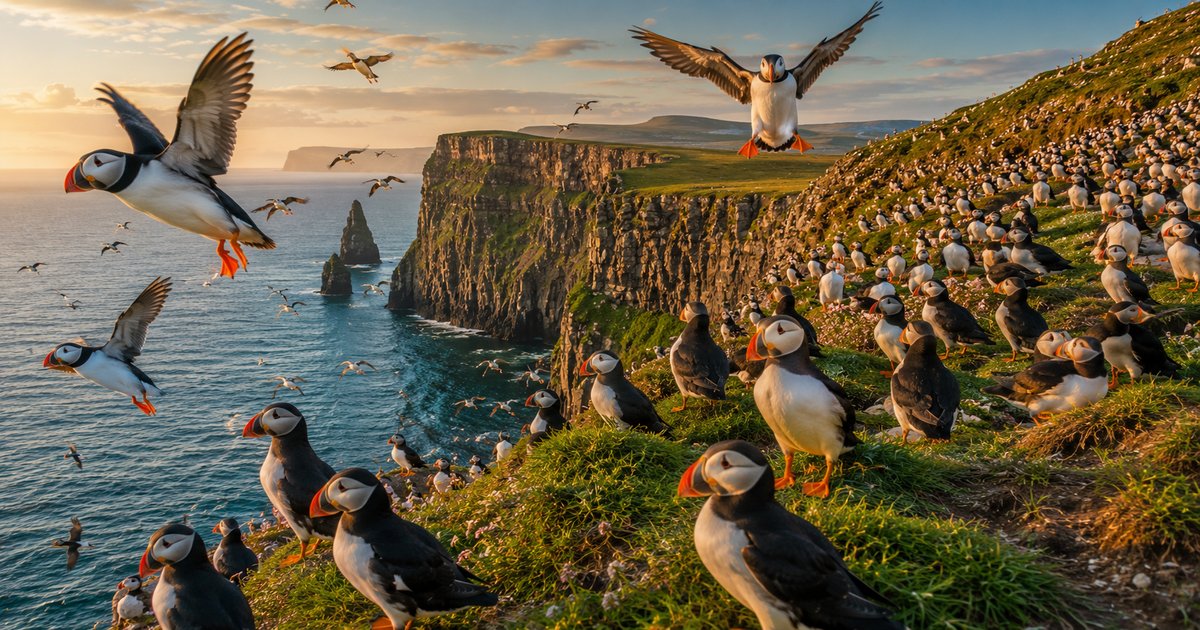
Iceland, perched between the North Atlantic and the Arctic, is home to some of Europe’s most spectacular seabird colonies and offers the chance to observe Arctic specialties in a dramatically beautiful volcanic landscape. Millions of seabirds breed here each summer while Gyrfalcons — the world’s largest falcon — hunt year-round across the interior.
Star Birds
Atlantic Puffin
Iceland hosts the world’s largest Atlantic Puffin colony — an estimated 8-10 million birds breed here each summer, representing roughly 60% of the global population. The Westman Islands (Vestmannaeyjar) and Latrabjarg cliffs hold enormous colonies where puffins land within arm’s reach of observers. The puffins remain at their colonies until August when they silently disappear back to the open ocean.
Gyrfalcon
The Gyrfalcon — a supreme predator of Arctic and sub-Arctic wilderness — breeds year-round on Iceland’s lava cliffs. The island holds all colour morphs: white (rare), grey (common), and dark brown forms. Territorial nesting pairs return to the same cliff faces year after year.
Arctic Shorebirds
Whimbrel, Golden Plover, Red-necked Phalarope, Dunlin, and Purple Sandpiper breed on Iceland’s heath and wetlands. Red-necked Phalaropes spinning on arctic pools are a memorable sight. The Snipe’s dramatic drumming display — produced by vibrating outer tail feathers — fills the air on calm evenings.
Best Time to Visit
- May-Aug: Breeding season; puffins present; midnight sun; arctic terns nesting
- Sep-Oct: Autumn migration; first winter visitors arriving
- Jan-Mar: Gyrfalcon most visible; potential for Snowy Owl; Northern Lights
Travel Tips
Reykjavik is Iceland’s gateway with extensive international connections. The Ring Road (Route 1) provides access to birding sites around the entire island. The Latrabjarg cliffs (Westfjords) require a 4WD track but reward with the finest seabird spectacle in Europe. Rental car is essential outside Reykjavik.
