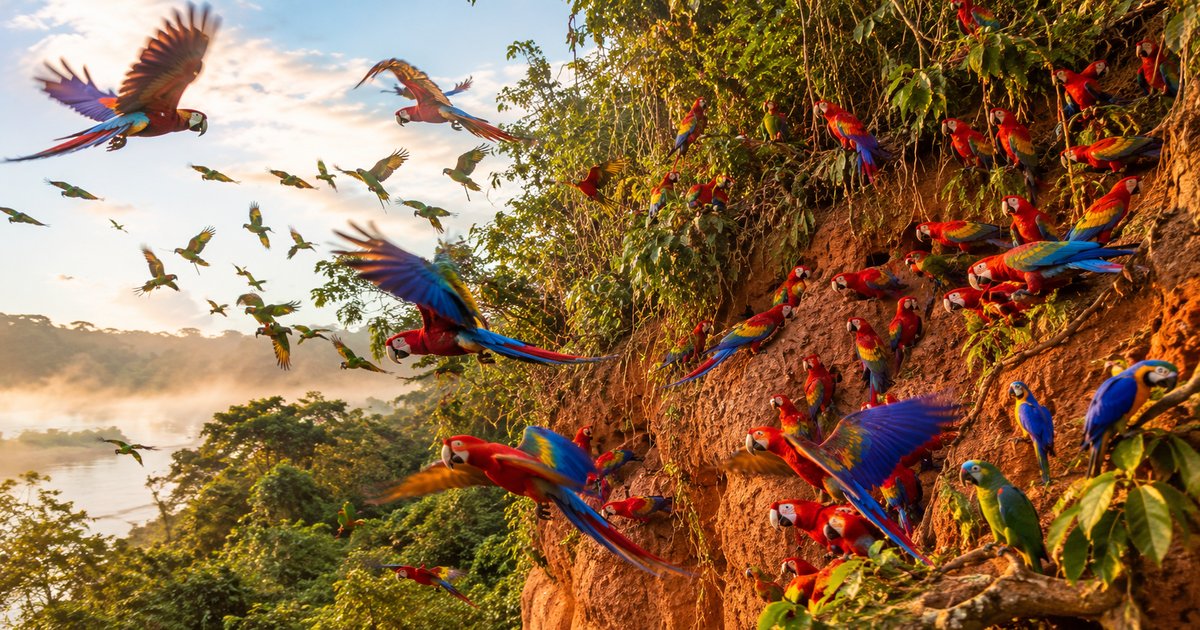
The Amazon Basin of Brazil contains the highest bird diversity on Earth — over 1,300 species have been recorded in the region around the junction of the Rio Negro and Amazon rivers alone. Scarlet and Hyacinth Macaws, toucans, tanagers, and the apex predator Harpy Eagle are among the treasures awaiting in the world’s greatest tropical forest.
Star Birds
Harpy Eagle
The Harpy Eagle is the largest and most powerful raptor in the Americas — a grey-and-black giant with enormous talons capable of hunting monkeys and sloths. Finding a Harpy Eagle nest (regularly located at specific sites in the Pantanal and Amazon fringe forest) is among the ultimate goals of Neotropical birding.
Hyacinth Macaw
The Hyacinth Macaw — the world’s largest parrot at one metre long, in vivid cobalt blue — is found in the Pantanal and Cerrado habitats adjacent to the Amazon forest. Populations have recovered strongly through conservation efforts; the Pantanal now offers near-certain sightings.
Antbirds
The antbird family, with over 200 Amazonian species, represents one of the great evolutionary radiations of tropical birds. Following army ant swarms to observe the mixed-species feeding frenzies of antbirds, antpittas, and woodcreepers is one of the Amazon’s most thrilling spectacles.
Key Destinations
Manaus is the gateway to central Amazon birding — river lodges along the Rio Negro offer canopy tower access and excellent guiding. The Pantanal (accessible from Cuiaba) provides open-country birding for macaws and raptors. Cristalino Lodge (near Alta Floresta) is widely considered Brazil’s finest birding lodge.
Best Time to Visit
- Jun-Sep: Dry season; low water exposes river beaches; easier forest access
- Nov-May: Wet season; varzea (flooded forest) accessible by canoe; fruit abundant
Travel Tips
Flights from Sao Paulo or Rio de Janeiro connect to Manaus and Cuiaba. High humidity (up to 90%) makes mornings the most productive birding time. A specialist guide is essential — bird diversity is so high that even experienced birders struggle without local expertise. Bring a spotting scope for canopy species.
